
The prostate is a gland in men that surrounds the beginning of the urethra and produces protective and nourishing fluids for sperm. Prostate cancer is the most common visceral cancer in men in developed countries worldwide. This cancer is often referred to as “the cancer of older men” because the strongest risk factor for its development is increasing age.
On average, one in 58 men aged 50-59, one in 21 men aged 60-69, and one in 12 men over 70 will be affected by this disease.
Predisposing factors other than age:
Hormonal Factors:
These factors are effective in both the onset and progression of the disease. Therefore, hormonal therapies are an important part of the treatment for advanced prostate cancers. Studies have shown that higher levels of testosterone in the blood are associated with an increased risk.

Nutrition:
– Overweight, high caloric intake, and high fat consumption are all independent risk factors for increasing the risk of prostate cancer and can sometimes double the risk.
– High consumption of red meat more than doubles the risk compared to the general population.
– Isoflavones (in soy) and selenium (found in grains, nuts, seafood, and poultry) reduce the risk.
– Tomatoes contain lycopene, and over fifty studies have shown its benefit in reducing the risk of prostate cancer. It has also been observed that this benefit is greater in cooked tomatoes than raw.

Family History:
The presence of a family member with prostate cancer, especially if the age of onset is under 55, increases the risk. Individuals with one affected first-degree relative have a 2.2 times higher risk than other people in the community. If two family members are affected, the risk is five times higher.
This increased risk cannot be limited to a single cause. It has been observed that both shared environmental and nutritional factors are effective, as well as sometimes hereditary predisposition.
Gene-Related Factors:
It has been observed that differences in DNA sequences in East Asian men play a protective role against prostate cancer, and therefore these individuals are less affected than Western men. Research on the role of genes is still ongoing.
Other Factors:
In some studies, a history of chronic or recurrent inflammation due to gonorrhea and syphilis may be effective.
Smoking does not increase the risk of developing this specific type of cancer, but in affected patients, smokers have higher mortality rates.
Screening and Disease Detection
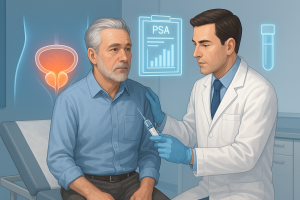
Since the 1980s, after the discovery of the blood marker PSA, early diagnosis of prostate cancer significantly increased. However, at the same time, the number of unnecessary and negative biopsies also increased. (Definitive diagnosis is ultimately made by biopsy, and the PSA marker is only an initial screening.)
Also, given that in men aged 70 and above, at least ten percent of the population (some studies up to 50%) have prostate cancer but due to its slow course, they ultimately remain asymptomatic and die of natural causes or other diseases. Therefore, the opinions of various international organizations regarding screening differ, but the American Urological Association guidelines state that men aged 40-70, if they wish, especially if they have the risk factors mentioned above (most importantly, a positive family history), can be screened annually with PSA and examination.
Symptoms and Diagnosis:
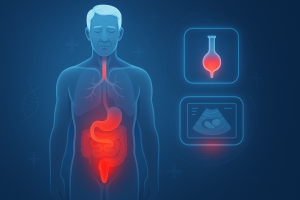
The clinical course and speed of prostate cancer vary among different patients, but generally, it has a slow course and is asymptomatic in the initial months or years of onset. After progression, urinary symptoms such as difficulty urinating, urinary retention, and chronic obstruction, sexual dysfunction, involvement of lymph nodes, bones, and sometimes viscera such as the liver develop. Diagnosis of the disease is usually made by a urologist through examination and biopsy.
Treatment:
Prostate cancer treatment has dramatically advanced in recent years, especially in the last fifteen years, with the discovery and approval of 5 important drugs, new surgical techniques, and the use of modern radiotherapy methods with lower risk and greater effect.
Depending on the extent of the disease and its speed and course, which are determined by histological and blood tests and imaging, treatment can range from watchful waiting in low-risk cases to prostatectomy, radiotherapy, hormonal therapies, or a combination of them; and in metastatic cases, hormonal therapy, chemotherapy, and nuclear medicine drugs (radiopharmaceuticals).

Excerpted from:
Devita, Hellman, and Rosenberg’s CANCER
Perez and Brady’s Radiation Oncology
Comments