
Colon cancer is one of the most common gastrointestinal cancers, affecting 1.2 million people annually worldwide. In the United States, its incidence is declining due to prevention, early detection, and treatment methods.
Risk Factors
Genetic and environmental factors play a role in the occurrence of colon cancer.
Hereditary Factors: Several hereditary syndromes increase the likelihood of colon cancer, including FAP (Familial Adenomatous Polyposis), MUTYH-associated polyposis, and Lynch syndrome (or HNPCC).
Other Factors:
Advanced Age: The incidence of non-hereditary colon cancer dramatically increases after the age of 45-50. However, studies show that the age of onset for this disease has decreased, and some experts recommend screening starting around age 40.
Male Gender: In almost all countries, the incidence in women is lower.
Family History: A family history of colon cancer, even of the non-hereditary type, raises the risk to some extent.
Inflammatory Bowel Disease (Crohn’s and Ulcerative Colitis): In patients with these conditions, colon cancer screening is recommended 8-10 years after the onset of inflammatory bowel disease.
Obesity: Obesity, physical inactivity, and caloric intake have an independent relationship with colon cancer.
Nutrition: Excessive consumption of red meat, processed meats, and refined grains, as well as high intake of starch and sugar, increases the risk of colon cancer.
Consuming fiber-rich foods, fruits, and vegetables reduces the risk. Recent studies show a decreased incidence of colon cancer in coffee drinkers.
Note: The daily discussion revolves around the Dietary Inflammatory Index (DII). Food items with a high DII include sugar, trans fats, refined grains, red and processed meats, alcohol, and so on. High consumption of these substances has been linked to the occurrence of many diseases, including colon cancer.
Alcohol and Smoking: Have an independent relationship with colon cancer. Consumption of 20 pack-years of cigarettes is associated with the occurrence of adenomas (pre-cancerous lesions, often polyps), and consumption of more than 35 pack-years is associated with cancer incidence.
Folate, calcium, magnesium, and vitamin D deficiency have also been associated in some studies.
Screening

Given that colon cancer often develops from pre-cancerous lesions and is a cancer that is highly curable if detected early, its screening is recommended as follows:
⁃ For the general population: Colonoscopy every 10 years starting at age 50 (some experts recommend 40), or every 5 years if other methods are used: sigmoidoscopy, barium imaging, a combination of stool tests.
⁃ In individuals with inflammatory bowel disease, 8-10 years after diagnosis.
⁃ In cases of family history: If a first-degree relative was over 60 years old; colonoscopy every 10 years starting at age 50. If under 60 or two relatives; every 5 years starting at age 40 or 10 years earlier than the affected individual’s age.
⁃ In cases of hereditary diseases such as Lynch syndrome and familial polyposis, special guidelines exist. (Consult with your treating physician.)
Symptoms
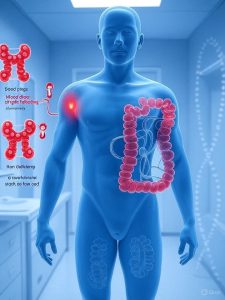
Symptoms may vary depending on the affected part of the intestine. In the left side, symptoms include changes in bowel habits, partial or complete obstruction, and rectal bleeding, which is usually more symptomatic and detected earlier than right-sided cancer.
In cancers of the proximal colon (right), iron deficiency anemia usually occurs and becomes symptomatic later.
Note: Iron deficiency anemia in men, unlike women, can never be physiological or normal, and in the absence of a cause such as recent surgery or bleeding, the gastrointestinal tract should be investigated.
Treatment
In this cancer, treatment also depends on the stage. Fortunately, in early stages, it is curable with surgery and, if necessary, the addition of chemotherapy (with or without radiotherapy).
Also, in cases of metastasis to other organs, if conditions permit and according to the surgeon’s opinion, it may still be resectable. In advanced cases, chemotherapy prevents disease progression and controls symptoms.
Excerpted from
Devita, Hellman, and Rosenberg’s CANCER
Perez and Brady’s Radiation Oncology
Comments